
History Walk and Street Food in Yokohama Chinatown
Explore Yokohama Chinatown’s history and visit the exteriors of Kanteibyo and Masobyo temples while learning about Chinese community life and traditions. Along the way, discover the neighborhood’s distinctive gates and sample Chinese street food of your choice.
Wed, Dec 30, 2026 15:30–17:30
Japan time · Meet at 15:30
Meeting place Ishikawacho (Motomachi-Chukagai) Station Open in Google Maps Place Yokohama Chinatown, Yokohama Open in Google Maps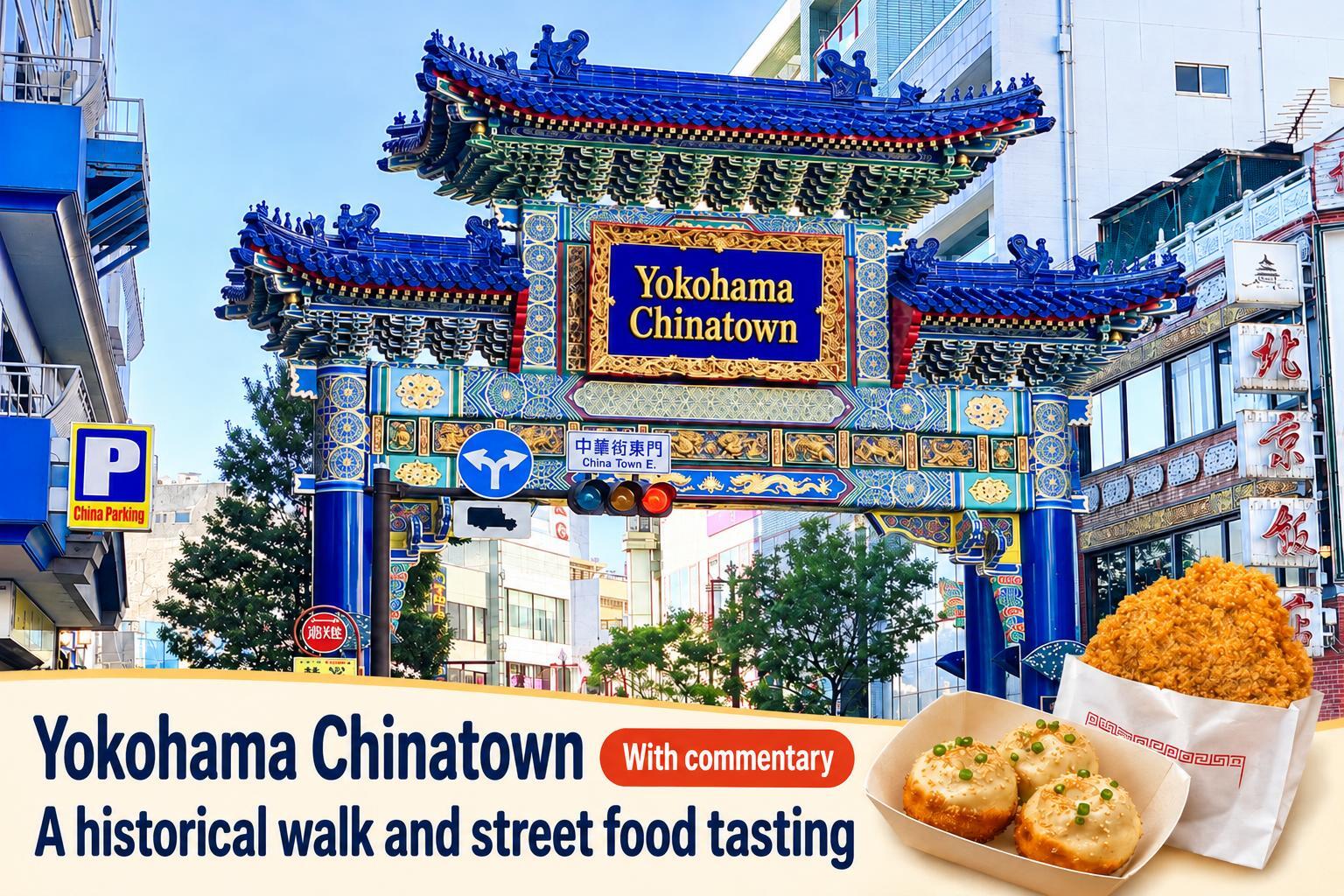
Book this experience
English is all you need. The host confirms within 24 hours.
from $98 for 1 person
6 ticket types. You choose one when you book.
Total price, service fee included. Prices in USD are approximate (US$1 = ¥150); charged in Japanese yen (¥14,700 for 1 person).
No account needed.
Participants
1 / no limit
Minimum 8 participants. If fewer people sign up, the host cancels the event and you get a full refund.
Tickets
Choose your ticket when you book. Prices are the total for 1 person, service fee included.
Early Bird 1
$98
Early Bird 2
$99
Early Bird 3
$101
Early Bird 4
$103
Early Bird 5
$105
Early Bird 6
$107
About this event
We’re a group that enjoys exploring different parts of Tokyo on foot, discovering their history, art, and culture, much like the Japanese TV program Bura Tamori. We offer simple explanations, so you’re welcome even if you’re new to these subjects and just curious to learn more.
About This Event
Let’s enjoy both a food walk and a history walk through Yokohama Chinatown! We’ll explore colorful paifang gates and Chinese temples, while sampling treats such as steamed buns, soup dumplings, and Chinese sweets. Behind the neighborhood’s distinctive atmosphere is the history of a Chinese community that has thrived for more than 160 years, since the opening of Yokohama’s port at the end of the Edo period.
Why Did Yokohama Chinatown Develop Here?
After Yokohama opened its port in 1859, Chinese people who came to Japan alongside Western merchants acted as intermediaries in trade with Japanese people. Sharing Chinese characters with Japanese speakers and familiar with Western languages, they played an important role in the trade of raw silk and tea. Businesses and homes gathered in the settlement near the port, laying the foundations for today’s Chinatown. We’ll introduce how land in Yokohama Shinden, once used for fields, developed into an international commercial district.
Kanteibyo Temple: A Romance of the Three Kingdoms Hero Becomes a God of Business
Yokohama Kanteibyo enshrines Guan Yu, a real military commander who appears in the Romance of the Three Kingdoms. Respected for valuing loyalty and trust, he has also been worshipped in overseas Chinese communities as a deity of business prosperity. The temple is said to have begun with a small shrine in 1862. The current ornate temple, rebuilt in 1990, is the fourth version. Look out for the roof decorations, dragon carvings, and vivid architecture. Entry to the building requires a fee, but we will not go inside during this event.
Masobyo Temple: A Goddess Who Protects People at Sea
Yokohama Masobyo enshrines Mazu, a goddess who protects the safety of people at sea. She has been worshipped in port cities around the world, including coastal areas of China and Taiwan. The Yokohama temple opened in 2006 and stands on the former site of the Qing dynasty consulate. As we admire its altars and decorations, which differ from those of Japanese shrines and temples, we’ll learn about life in the overseas Chinese community and beliefs connected to the sea. Entry to the building requires a fee, but we will not go inside during this event.
Ten Paifang Gates: Feng Shui Secrets Behind the Gates
There are ten paifang gates in Chinatown. Their arrangement reflects Chinese feng shui, with the Four Symbols: the Azure Dragon in the east, the Vermilion Bird in the south, the White Tiger in the west, and the Black Tortoise in the north. Zenrinmon Gate on Chinatown’s main street was built in 1955 as a symbol of postwar recovery, and helped establish the name “Chinatown” for the area. Learning about the gates’ shapes, colors, and guardian figures makes the walk even more interesting.
Street Food: A Taste of Different Chinese Regions
Chinatown is home to restaurants serving Cantonese, Shanghai, Sichuan, Beijing, Taiwanese, Hong Kong, and other cuisines. Choose what you’d like to try, such as steamed buns, pan-fried soup dumplings, sesame balls, and mooncakes. The restaurant trade, once one of the occupations of the overseas Chinese community, developed into a signature industry of the neighborhood by the 1970s. We’ll also pay attention to the differences between the dishes and the signs outside the shops.
Walking through the neighborhood and viewing the temple exteriors are free.
First-time participants and solo visitors are welcome, and you don’t need to know much about history. With simple explanations along the way, we’ll discover interesting sights and flavors together.
Itinerary
1. Meet and introduce ourselves
2. Explore the area
3. Finish at the scheduled time
Please Note
- The event will go ahead in light rain and will be canceled in heavy rain. The organizer will make the decision.
- The event will be canceled if the minimum number of participants has not been reached six hours before the start. The organizer may make this decision earlier in some cases.
- It may be difficult to meet up with the group if you arrive late, as the organizer may not be able to check messages during the event. The organizer cannot take responsibility if you are unable to join the group. Direct messages may not be checked promptly, so please use the event message thread.
- If a planned venue cannot be accessed for any reason, the group will discuss what to do at the time.
- Photos may be taken during the event as appropriate.
- If a participant engages in sales activities, solicitation, or disruptive behavior, the incident will be reported to Tsunagate, and they will not be allowed to join future events.
Please see the images below for photos from previous events.
This is a translation of the organizer's description, which is written in Japanese. English is all you need on the day.
How it works
- Choose your group size and pay by card or Apple Pay. Your card is only authorized at this point.
- Verify your email address to send your request. The host replies within 24 hours; you are charged only when they confirm.
- Once confirmed, we email you the meeting point and time.
- On the day, join the event with local people. English is all you need.
Cancellation policy
- Cancel up to 7 days before the event: full refund.
- After that, a cancellation fee is charged on the amount you paid: 30% from 6 to 3 days before, 50% 2 days before, 80% the day before, and 100% on the day of the event.
- Cancellations within 1 hour of booking are fully refunded (except on the day of the event).
- This event needs at least 8 participants. If it does not reach that number, the host cancels it and you get a full refund.
- If the organizer cancels the event (for example, due to bad weather), you get a full refund.
- To cancel, use the cancellation link in your booking confirmation email (no login needed).
Have a question?
Ask the host anything about this event, in English. We translate it into Japanese and email you their reply. No account needed.
Ask the hostBook this experience
English is all you need. The host confirms within 24 hours.
from $98 for 1 person
6 ticket types. You choose one when you book.
Total price, service fee included. Prices in USD are approximate (US$1 = ¥150); charged in Japanese yen (¥14,700 for 1 person).
No account needed.